
How do Socially Excluded People Understand Religion?
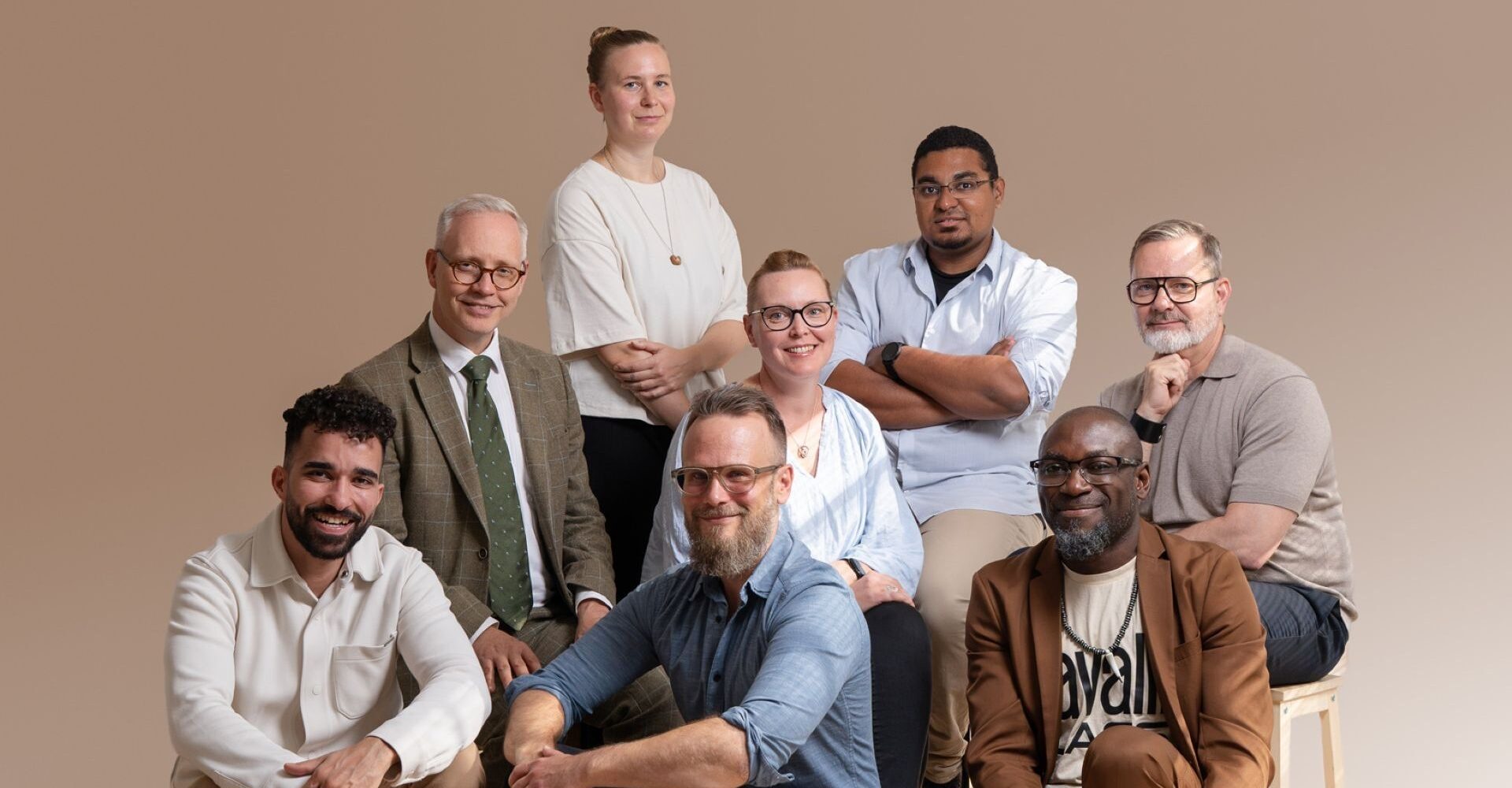
At Åbo Akademi University’s Centre of Excellence RelEx (Religion and Social Exclusion), researchers have developed a new methodological framework to investigate the significance of religion for individuals and groups. The framework is now being applied in research among socially excluded young adults – in prison, from ethnic minorities, and identifying as LGBTQI+. At the heart of RelEx is the Faith Q-Sort research instrument.
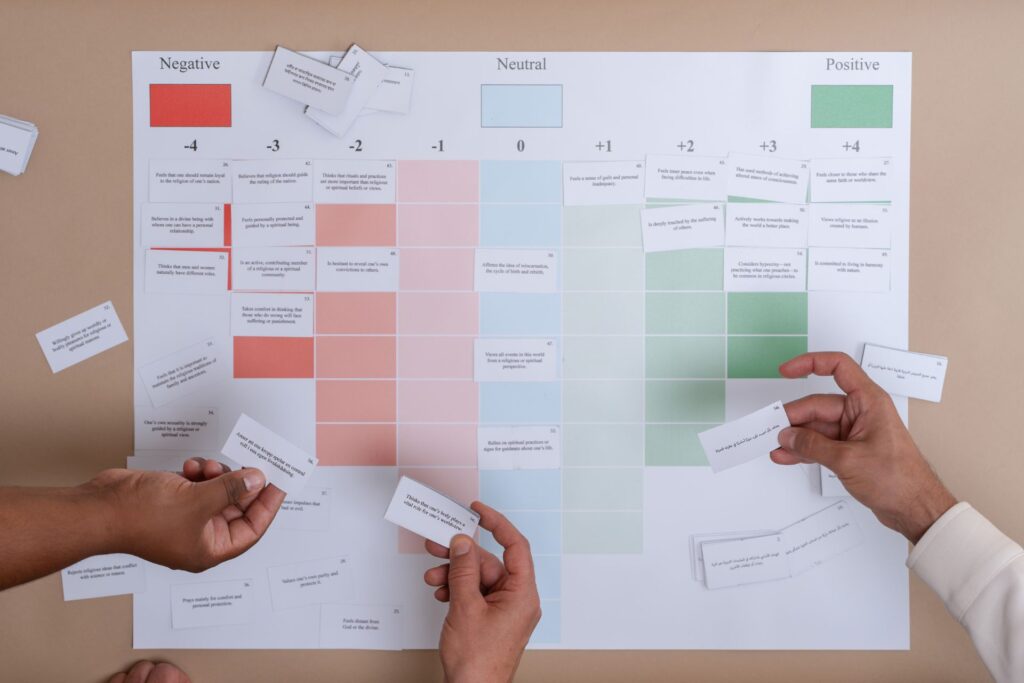
Professor Peter Nynäs rolls out a plastic sheet with a sorting grid onto the table. The plastic sheet contains 59 red, blue, and green squares. He hands me a deck of 59 cards, each containing a statement related to religion, spirituality, or worldviews in a broader sense.
“Experiences inner peace, even when facing difficulties in life”, “Believes in a divine being with whom one can have a personal relationship”, and “Has a strong sense of something spiritual or sacred in nature” are some examples of the statements.
“Participants are asked to consider each statement and place the card on the plastic sheet according to how well it reflects their own views,” says Nynäs, who leads the RelEx Centre of Excellence.
The squares on the plastic sheet are arranged in columns ranging from minus four to plus four. Once all 59 cards have been placed, they form a pattern unique to each participant. Researchers compare these patterns quantitatively and draw statistical conclusions, but the conversations that take place during the process are equally valuable.
“The process often prompts discussions about the meaning and definitions of the statements, and these conversations provide us with qualitative data. We ask follow-up questions such as: Why is this important to you? How? In what way?” says Nynäs.
The Faith Q-Sort instrument is an adaptation of Q methodology, which is used to study people’s subjective viewpoints, for example in psychology. Completing the Faith Q-Sort generally takes between one and two hours. It is preceded by a comprehensive survey tailored to the target groups and complemented by a follow-up interview.
Some participants find the concept unfamiliar and struggle to respond to the statements, while others experience the Faith Q-Sort as a private and personal conversation that borders on therapy.
“It is not uncommon for participants to want to photograph their cards once they have arranged them. The result becomes a kind of map of personal values,” says Nynäs.
Many People Fall Outside Traditional Categories Used in the Study of Religion
RelEx stands for Religion and Social Exclusion. It is one of four Centres of Excellence at Åbo Akademi University, co-funded by the Åbo Akademi University Foundation. The research focuses on the religious outlooks and values of young adults subjected to different forms of social exclusion, including prisoners, Indigenous people, and members of sexual and gender minorities.
“We know very little about the religious outlooks and values of these groups. Without this knowledge, our understanding of the role of religion remains limited and incomplete. That is why this research is important,” says Peter Nynäs.
He points out that previous research on social exclusion has primarily focused on economic factors.
RelEx is an international research project involving researchers and participants from Finland, Ghana, India, Peru, and the Philippines. The five-year project, which runs until 2028, is currently in the data collection phase. One early observation has already emerged.
“Many of the people we interview position themselves outside the standard categories commonly used in the study of religion, such as religious, spiritual, or secular. They often describe themselves in entirely different ways. This suggests that the traditional framework used in the study of religion may be too narrow and that we need a broader understanding of people’s religious outlooks and values in the future,” says Nynäs.
Researcher Ali Ali agrees:
“Rather than looking for a common thread or similarities in people’s responses, I see our goal as diversifying perspectives and challenging assumptions that are often taken for granted. At its core, this is about understanding how people navigate experiences of social exclusion and insecurity. By questioning dominant norms and stereotypes, we can contribute to a safer world, or at least foster fairer and more caring research encounters and conversations.
Ethics Are Central: Missteps Can Put Both Participants and Researchers at Risk
RelEx builds on YARG (Young Adults and Religion in a Global Perspective), Åbo Akademi University’s previous Centre of Excellence project, which explored religion among young adults from a global perspective. The international research networks established through YARG have proven invaluable to RelEx, as the two projects employ similar methodologies and focus on the same target group: young adults.
“Young people are often more open to discussing spirituality, religiosity, and secular perspectives. They are in a period of change and development, which makes them their perspectives an important reflection of society. They are also underrepresented in research,” says Karoliina Dahl, a member of the RelEx research team.
At the same time, many of the people the researchers hope to interview are sceptical of research itself.
“Many of the queer migrants I have spoken to during my fieldwork in Finland have been approached by researchers repeatedly. They may view the researcher as an interrogating authority figure or perceive research as a self-serving endeavour and a desperate search for data. That neither interests nor impresses them,” says Ali Ali.
Several researchers agree that data collection can be challenging. The topics under discussion are deeply personal and may carry significant social consequences if participants’ responses were ever disclosed.
In some countries, the risks are even more tangible. In Ghana, for example, members of sexual minorities face a heightened risk of violence and persecution. In such contexts, ensuring a confidential and secure environment for meetings between researchers and participants is essential.
“We must constantly consider the potential consequences our research may have for participants. Our goal is always to ensure that the findings improve the circumstances of vulnerable groups,” says Karoliina Dahl.
Project Coordinator Islam Sabry agrees. Building trust between researchers and participants often takes time.
“Some participants in earlier research projects hoped that sharing their experiences would lead to meaningful changes in their lives, but nothing happened. That is why it is so important for us to communicate our findings beyond academia and ensure they reach wider audiences. We also encourage our researchers to write blog posts on the RelEx website, www.abo.fi/relex, throughout the research process.”
In many of the countries included in the study, researchers must also establish trust with local authorities so that, for example, prison staff can be confident that information shared within correctional facilities will be treated with the utmost confidentiality.
“Local research teams play a crucial role. Their responsibility extends far beyond data collection. They are instrumental in reaching our target groups and collaborating with local authorities and organisations. There are many ethical and legal challenges that we must work together to resolve when dealing with sensitive topics and vulnerable groups,” says researcher Linda Annunen.
Finding Concepts That Work Across Cultural Boundaries Is a Challenge
Before data collection began, the researchers devoted considerable effort to refining the methodology. The number of cards included in the Faith Q-Sort instrument was reduced, and one of the biggest challenges was translating the statements on the cards without altering their meaning across different languages.
“Cultures can differ significantly, and concepts may be understood and used in different ways. This is one of the fundamental challenges of cross-cultural research and an issue we constantly work with,” says Peter Nynäs.
Islam Sabry agrees. He was personally involved in translating the cards into Arabic.
“Sometimes a word simply has no equivalent in another language. In those cases, we retain the original English term and explain it to the participant instead. We may have to unpack an unfamiliar expression piece by piece until it becomes something the participant can meaningfully respond to,” says Sabry.
Researcher Linda Annunen adds:
“Even though we have invested significant effort in making the research instruments as inclusive and open as possible, we continue to learn from the process. Now that field reports from the different countries are beginning to arrive, we can see that the work is not yet finished. There is still much that needs to be refined.”
The Foundation Makes RelEx Possible
Large-scale projects such as RelEx are rare within the study of religion. Conducting a five-year international research project across challenging research environments has been made possible through funding from the Åbo Akademi University Foundation. RelEx also benefits from the foundation’s earlier investment in YARG, the Centre of Excellence project through which international research networks were established.
“Without the foundation’s support, we would not have been able to build this network. We now have the opportunity to conduct research on a scale that few others in the world can match, and we are large enough to make a meaningful contribution to international scholarship. This demonstrates how long-term funding can generate significant results,” says Marcus Moberg, Professor and Deputy Director of RelEx.
“The funding has created truly unique opportunities possible. It allows us to focus on the research over an extended period. Today, the humanities often suffer from a lack of time and resources required to carry out large-scale projects,” says Peter Nynäs.
RelEx also plays a prominent role within Åbo Akademi University itself. One example is the University’s Master’s Programme in Social Exclusion. Alemanji Aminkeng Atabong, Senior University Lecturer and researcher within RelEx, highlights the importance of involving both faculty members and students in the work of the Centre of Excellence. For him, as for many of the other researchers, RelEx serves as an important platform for developing new research initiatives.
When the project concludes, the researchers hope to have helped fill an important gap in knowledge concerning the religious and non-religious outlooks and values of socially excluded young adults. Equally important is the further development of the project’s methodology so that it can support future research among vulnerable and socially excluded populations. Ensuring that the findings are communicated beyond academia and reach the groups they concern remains another key objective.
Peter Nynäs hopes to continue developing the Faith Q-Sort instrument to make it even broader and more inclusive.
“I would like to expand it further so that it moves beyond religion alone and focuses more broadly on people’s outlooks and values. A Worldview Q-Set – that is the next goal.”
About RelEx: Religion and Social Exclusion
Centre of Excellence at Åbo Akademi University, 2024–2028, co-funded by the Åbo Akademi University Foundation.
Research in brief: RelEx examines how socially excluded people understand religion, spirituality, and their outlooks and values. Participants are young adults in Finland, Ghana, India, Peru, and the Philippines who are subjected to three forms of social exclusion: imprisonment, belonging to an ethnic or Indigenous minority (the Sámi, Fulani, Awajún, Santal, and Batak/Tagbanua), or identificatifying as LGBTQI+.
Methodology: A mixed-methods framework developed specifically for research among vulnerable and socially excluded populations. The framework consists of three complementary research instruments: a short targeted survey including the Portrait Values Questionnaire (PVQ), the Faith Q-Sort instrument (FQS), and follow-up interviews.
RelEx builds on YARG – Young Adults and Religion in a Global Perspective, Åbo Akademi University’s Centre of Excellence project from 2015–2018, which was co-funded by the Åbo Akademi University Foundation and the Academy of Finland.
Text: Sebastian Dahlström
Image: Valentina Morales Buschmann
This article was originally published in Inblick 2026, the magazine of the Åbo Akademi University Foundation. The original language is Swedish. Translation: Sandra Edfelt.
You might also be interested in the following articles.
-

-
 30.12.2022
ÅAU Centres of Excellence in Research 2024-2028 – The application round is open
-
